Rooted in Two Places: How Central American Diaspora Organizers Are Rewriting the Rules of Political Power
Grow up straddling two worlds and you learn to move between them fluently. You know when to code-switch, when to translate — not just language but context, history, grief, and aspiration. For millions of Central American Americans, that bicultural fluency has always been a private skill, a survival tool, something you carry quietly through your daily life in the US while maintaining a parallel emotional citizenship in Guatemala, El Salvador, Honduras, or Nicaragua.
But something has shifted. A generation of organizers, activists, and community leaders — many of them second or third-generation, raised in Houston suburbs and DC neighborhoods and the San Fernando Valley — are turning that private fluency into a public political force. And the effects are rippling in both directions across the isthmus.
Not Your Parents' Activism
The Central American American political tradition has deep roots. The solidarity movements of the 1980s, organized in response to US-backed violence in El Salvador, Guatemala, and Nicaragua, were genuinely significant — and largely led by immigrants who had survived those conflicts firsthand. They were fighting for recognition, for asylum, for the US government to acknowledge its role in the catastrophes driving people north.
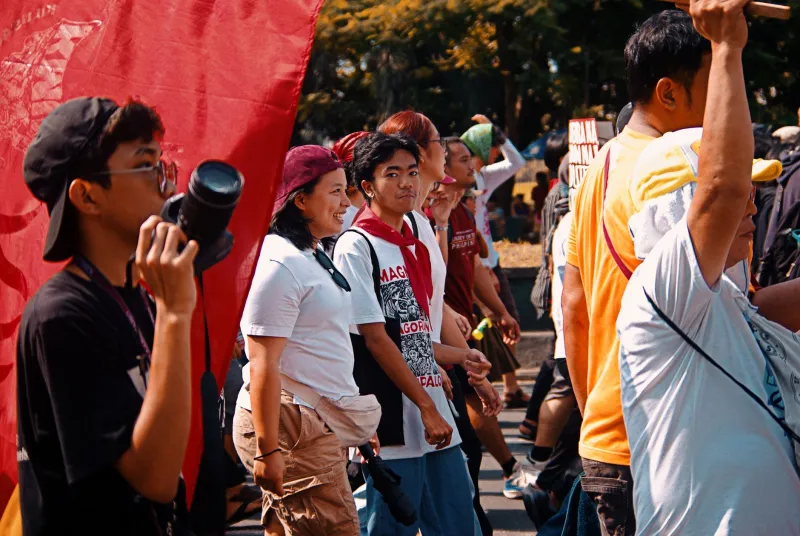
Today's organizers are working from a different position. Many of them grew up in the US, hold citizenship, vote in American elections, and have spent their formative years building organizing skills in domestic political contexts — through racial justice movements, labor organizing, campus activism. They're not asking for recognition. They're demanding power.
"My parents came here and fought to survive," says one organizer based in Los Angeles who works on both immigration policy advocacy and electoral politics in Guatemala. "We grew up watching them fight to survive. Now we're in a position to actually shape what happens — here and there. That feels different. It is different."
The Dual-Track Strategy
What makes this generation's approach distinctive is the deliberate, strategic way many of these organizers are working both tracks simultaneously. On the US side, they're engaged in the full spectrum of domestic political activity: voter registration, candidate support, lobbying, litigation, coalition-building with other communities of color. On the Central American side, they're funding civil society organizations, amplifying democratic movements on social media, facilitating connections between local activists and international human rights bodies, and in some cases returning to their ancestral countries to participate directly in political life.
This dual-track approach creates a kind of political leverage that's genuinely novel. When a Guatemalan American organizer in Chicago is simultaneously turning out voters for a local aldermanic race and fundraising for indigenous rights organizations in Guatemala's western highlands, she's building a form of transnational political capital that neither the US political establishment nor Central American governments quite know how to handle.
For US foreign policy, the diaspora's influence is most visible around moments of crisis. When democratic backsliding accelerates — as it did dramatically in Nicaragua under Ortega, or more recently in Guatemala with judicial interference — diaspora-led coalitions have been among the most vocal and effective advocates for strong US government responses. They have the cultural knowledge to explain what's actually happening on the ground, the language skills to communicate it in American political contexts, and the moral authority of people with personal stakes in the outcome.
The Complications of Belonging
None of this is simple or uncomplicated. The Central American diaspora in the US is not monolithic — it spans class lines, generational divides, regional identities, and political orientations that don't map neatly onto either American or Central American political categories. There are conservative Central American American communities who are deeply skeptical of progressive organizing frameworks. There are immigrants who fled leftist governments and have very different threat assessments than those who fled right-wing violence.
There's also the persistent question of legitimacy. Who gets to speak for communities they may not have lived in for decades — or ever? Second and third-generation diaspora members sometimes face pushback from people still living in Central America who feel that well-resourced Americans, however well-intentioned, are imposing political frameworks that don't fit local realities.
Organizers who are honest about this tension tend to be more effective. The ones who've built durable relationships across the isthmus are usually the ones who approach their ancestral communities with genuine curiosity and humility, who listen as much as they advocate, and who are willing to be told when they've gotten something wrong.
Social Media as the Bridge
If there's one technological factor that has fundamentally changed the nature of diaspora political organizing, it's social media — and specifically the way platforms like TikTok, Instagram, and WhatsApp have collapsed the distance between communities.
Activists in Guatemala City and Tegucigalpa are in constant real-time contact with diaspora organizers in the US. Video of a protest in San Salvador reaches East LA within minutes. A political development in Honduras can be contextualized, translated, and amplified to American audiences — including journalists and congressional staffers — faster than traditional media can cover it.
This speed changes the political calculus. It's harder for US administrations to quietly ignore democratic crises in Central America when diaspora communities can immediately mobilize attention and pressure. It's also harder for Central American governments to dismiss diaspora voices as irrelevant outsiders when those voices are clearly connected to influential constituencies in the United States.
What's at Stake
The broader context here matters. Central America is at a genuine democratic inflection point. Some countries are struggling to maintain basic rule-of-law institutions against corruption and authoritarian pressure. Others are attempting reforms that could, if sustained, fundamentally change the region's political trajectory. The US relationship with the region — shaped by a long and often ugly history of intervention — is being renegotiated in real time.
Into this moment steps a generation of Central American Americans who are, for the first time, politically organized enough and culturally fluent enough to genuinely influence the terms of that renegotiation. They're not intermediaries or translators for more powerful interests. They're principals — people with their own agendas, their own communities, and their own vision for what the relationship between the US and Central America could look like.
The isthmus has always been a place of connection — a narrow land bridge between continents, a meeting point of cultures and currents. The diaspora organizers of this generation are, in their way, living embodiments of that same bridging function. They stand in two places at once. And they're learning that standing in two places at once isn't a limitation. It's a superpower.